Title: Echoes of the Dead and Mexico Motorcycle Travel
Mexico welcomed us with open arms, its vibrant chaos swallowing us as our adventure bikes made our way through its winding roads and rugged mountain passes. Nowhere else do the dead return home to such a warm, wild embrace—a land where colors bleed into the streets, ancient rhythms thrum through the air, and the presence of those who’ve passed feels close enough to brush against your skin. This wasn’t just a ride; it was a plunge into something alive, something untamed. And this time, we didn’t miss it—Mexico’s Day of the Dead sank its teeth into us, and we let it.
I’m back in my den now, sprawled at my cluttered table with a patio chair creaking under me, the map still splayed out from my original planning. Last year, back in late March, I’d sat here, tracing routes with a sinking gut, thinking we’d blown our shot at the celebration—marigolds, candles, and mariachis locked away until November.
But fate, or maybe just dumb luck, had other plans. We’d rolled out from Phoenix in early April, a jagged line south to Oaxaca, and somewhere along the way, the timing bent. A detour, a delay, a whispered tip from a local—we found ourselves in the thick of a late Day of the Dead celebration, some small town’s twist on tradition that didn’t care about the calendar.
That day, we rode into a place—I think it was somewhere near Durango—where the sun beat down on a cemetery exploding with color. Vivid orange and yellow cempasúchiles blanketed the tombstones, their scent cutting through the dry desert air, sharp and sweet. Our bikes growled to a stop, dust swirling around us as we peeled off helmets and stood there, grinning like fools. Families moved through the graves, piling offerings—pan de muerto, tequila shots, faded photos—onto altars that glowed with marigolds and memory. Kids darted between headstones, laughing, while old women in rebozos murmured prayers or stories to the air.
Then night fell, and it hit us like a freight train—electric, unruly, alive. The cemetery transformed into a sprawl of light and sound, crosses gleaming under the flicker of a thousand candles, their shadows dancing across weathered stones. Mariachi bands roared to life, guitars strumming hard and fast, voices belting out notes that snaked through the graves and wrapped around us. The sky above was a slash of stars, and the music didn’t just echo—it pulsed, a lifeline tying the living to the dead in a way that didn’t give a damn about what you believed. Joey, Chris, Todd, and the rest of us stood there, beers in hand, letting it crash over us—the heat of the flames, the grit of the dust, the chords thumping through our bones.
I’d wanted to cannonball into it, to feel it raw and unfiltered, and that’s exactly what we got. It didn’t matter that I’m not a churchgoer—those crosses and candles weren’t asking for my resume. If you were devout, maybe you’d see something holy in the glow, a bridge to the beyond. But for me, it was a gut punch of human connection—loss and life tangled up together, no miracles needed. The scent of melting wax, the press of bodies in the crowd, the relentless surge of sound—it dared you to stand in it, to let it swamp your senses. And we did. We swallowed it whole, dust-caked and wide-eyed, trading shouts over the noise as the night burned on.
The ride itself had already been a beast—roads twisting into unpaved ribbons, signs half-readable, the air thick with smells I couldn’t name. We’d crossed the border with a hunger for the unknown, leaving behind smooth highways and diner stops for something jagged and real. Blogs had warned us off—bandits, bad water, broken roads—but not one mentioned this: the mariachis at midnight, the way a graveyard could feel more alive than any city we’d ever torn through. That was the gold we’d struck, and I’d pat myself on the back for it if I weren’t still half-dazed by the memory.
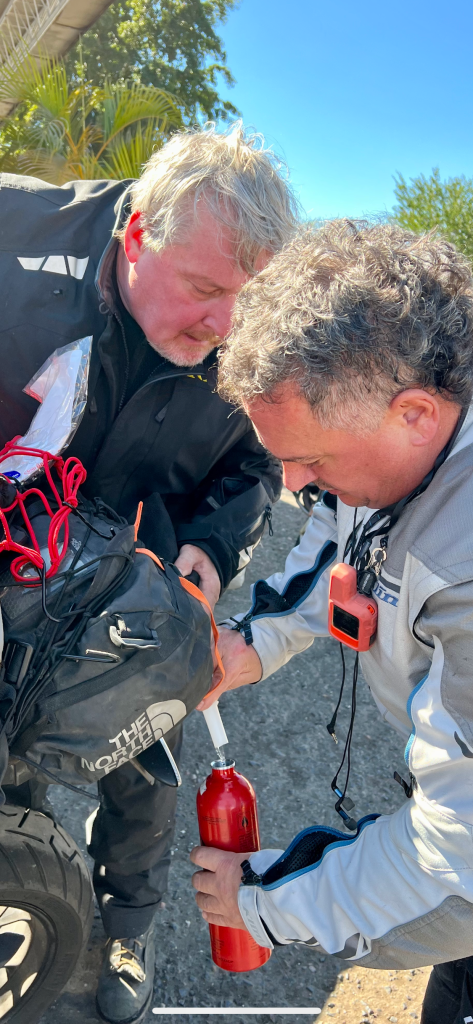
My crew held up like champs. Joey fixed a flat with a grin and a curse, Chris bartered for gas with a guy who spoke no English, Todd laughed off a near-spill on a mountain switchback. We’d stripped it down to the basics—tents, tools, a tank of gas, and a will to keep going. From Turtle Bay’s quirky Eiffel church to Oaxaca’s ancient valleys, we’d carved our path, and that night in the cemetery was the heart of it. Oaxaca’s spirit lingered even after—the Mixtec and Zapotec echoes in the soil, the way people carried the dead in their bones, not just on their calendars.
Sitting here now, I can still feel it—the, the candlelight flickering in my eyes, the weight of a night that honored the lost without bowing to dogma. I’d whispered a rider’s prayer before we left and paid a little extra for some of my road karma: foresight for what I could plan, fortitude for what I couldn’t, and wisdom to know the difference.
We got all three, and then some. Missing the “official” Day of the Dead didn’t matter in the end—we found its echoes anyway, woven into the land, thrumming through the people, alive in every mile we rode.
The road dared us, and we answered. That’s the story I’ll tell my older self one day—the night we stood with the dead in Mexico, bikes parked under a star-slashed sky, and felt the world pulse louder than ever.
—Trawlercat
April 2025


