Under a sky streaked with the soft hues of dawn, my companions—Chris, his wife Leasee, Patti, and I—embarked on what we believed was a segment of the Coastal Camino Português, part of the Portuguese Way (Caminho Português de Santiago) to Compostela. This ancient trail, worn by the footsteps of pilgrims across thousands of years, carries a quiet weight of history and purpose.
Among us, Chris stood out as a man of rich experience. Born and raised in South Africa, he carried the warm cadence of his native land in his voice. Years ago, he ventured to Britain, where fate led him to a cozy pub one rainy evening. There, amid the clink of pint glasses and the hum of conversation, he met his wife—a spirited Brit with a quick laugh.
Together, they later crossed the Atlantic to settle in America, where Chris channeled his resourcefulness into founding a crane business in Petaluma, a venture that now thrives under his steady hand.
As we walked, I found that once my feet settled into a steady rhythm, a transformation began to unfold within both my mind and body. If the body is willing—or, better yet, able—to sustain the effort, the experience becomes deeply enriching. Learning, I reflected, is hard work, demanding both endurance and introspection. As we ascended a steep incline, I caught myself humming the United States Marine Corps Hymn—“From the halls of Montezuma to the shores of Tripoli…”—its cadence mirroring our determined strides. It’s my way of distracting the mind from the physical reality of the trail.
Curiosity stirred within me about those opening lyrics, and I resolved to investigate their meaning at our next rest stop. When we paused, I quickly looked them up, satisfying my desire for context. Chris and I maintained our pace and conversation—his tales of crane operations blending with memories of South African sunsets—while Patti and Leasee followed at their own rhythm, their voices a soft hum behind us.
The Camino’s total distance from Porto to Santiago varies by route: the Coastal Route spans 280 kilometers (173 miles), while the Central Route covers 260 kilometers (161 miles). Each step revealed the scale of this timeless journey.
A lesser-known chapter of American history surfaced in my thoughts—how United States Marines once traversed 600 miles of Libyan desert to capture the port city of Derna in Tripoli.
In the early years of the United States, American merchant ships faced relentless attacks from Barbary pirates, who extorted ransoms for sailors and valuable cargos like olive oil. The enslaved individuals aboard were deemed expendable by their captors.
The breaking point came in October 1803, when Tripoli’s fleet captured the USS Philadelphia after it ran aground while patrolling the harbor. President Thomas Jefferson, resolute, declared, “No more!”—igniting a decisive response.
Our Marines landed and delivered a swift, overwhelming defeat—what could be described as a “can of whoop-ass”—a term signifying a thorough victory. Years later, the value of those enslaved lives became a point of contention, mattering more to one side than the other, which sought to maintain the practice. This foreshadowed the American Civil War (1861–1865), when eleven states seceded from the Union formed in 1776, leading to a nation-defining conflict.
The “Marines’ Hymn” holds the distinction of being the oldest official song in the U.S. military. Traditionally sung at attention as a mark of respect, it’s a challenge to perform while hiking, especially since I don’t know all the lyrics.
Its unknown author rearranged the Marine motto for poetic effect, prioritizing “From the halls of Montezuma, to the shores of Tripoli” over chronological order. Montezuma refers to a location in Mexico—the Halls of Montezuma sit atop a hill in Chapultepec, near the ancient Aztec city of Tenochtitlán, now part of a park in Mexico City and I have had the chance of being there.
A pattern emerged in my reflections: superior tactics, advanced weaponry, and unrelenting determination often lead to success. This principle resonates in modern conflicts, like the war in the Ukraine. The Ukrainian’s are now showing us how to fight a war with no navy but, how to defeat a country with one; and how to employ drones to do the work of countless pilots and much must more but, yet I regress.
During the Mexican-American War, Mexico’s troops wielded outdated arms—some nearly thirty years old, acquired from France and last used in the Napoleonic Wars—placing them at a disadvantage against a much better-equipped foe; that be us.
I could have delved into how the Spaniards, centuries earlier, arrived in these very regions with their own formidable tactics, reshaping history, but I chose to stay focused on the present journey but, before getting back to hiking the Camino……..
The First Barbary War’s pivotal moment came at the Battle of Derna (April–May 1805). First Lieutenant Presley O’Bannon led a small force of Marines and mercenaries across the desert to seize Tripoli’s key city. This triumph marked the first time the United States flag was raised in victory on foreign soil, immortalized in the hymn with “…to the shores of Tripoli.”
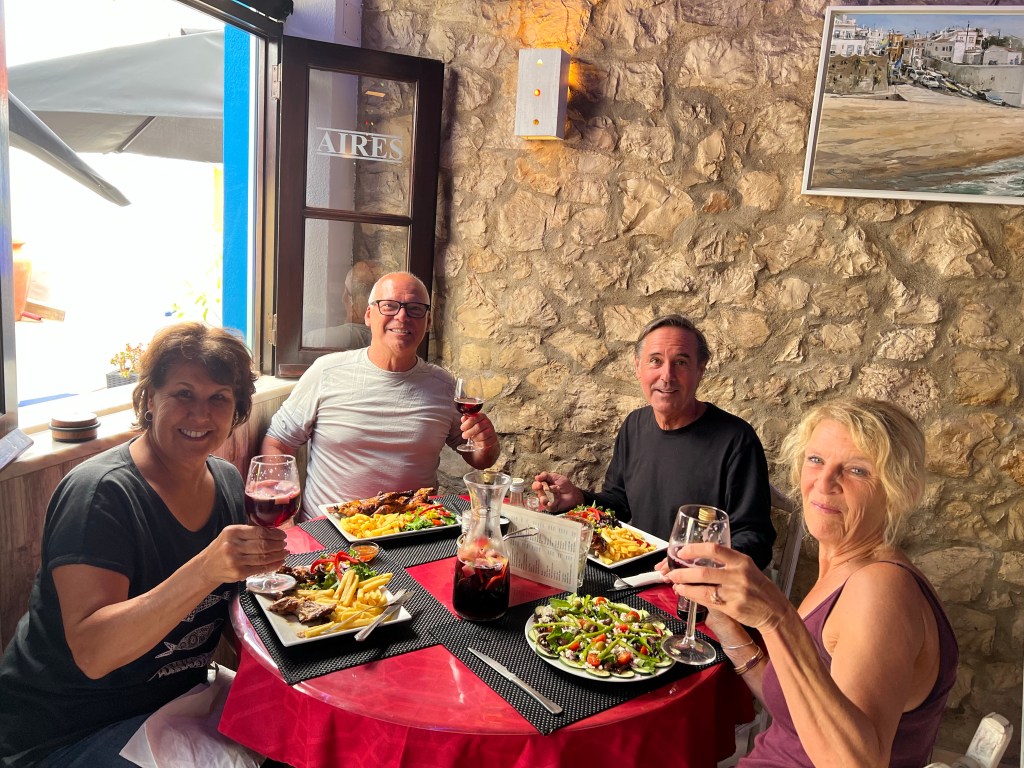
After our hike, rested and refreshed, we walked into Burgau to dine at Aries, a South African restaurant. The scent of meat cooking over an open fire greeted us, stirring a primal sense of satisfaction—perhaps a connection to our ancestors’ triumphs. We began with sangria, a fitting start, and chose barbecue chicken with robust flavor, its intensity a sensory delight.
Our server, a warm South African woman, engaged us effortlessly. Aries, owned and operated by a close-knit group of South African family and friends, exuded a welcoming authenticity that resonated with Chris, who shared a knowing smile at the familiar accents.
Over recent days, we’ve met some of the world’s most seasoned travelers—individuals whose lives paralleled ours in unexpected ways. Their openness fostered easy, meaningful exchanges. I’ve come to see travel’s essence as twofold: the people you encounter and the foods you taste, a sentiment that honors the spirit of Anthony Bourdain.
Yesterday, we felt youthful, as if nearly thirty again. Yet the world remains vast—greater than we can fully comprehend.
Yesterday, we felt youthful, as if thirty again. Yet the world remains vast—greater than we can fully comprehend. As this journey draws to a close, I find myself reflecting on the bonds forged along the way. This little tale is now dedicated to Patti, my steadfast companion, whose presence often makes every journey richer. Though, I must admit, she can be a bit of a stick in the mud at times—did I ever tell you about the time she refused to cross a rickety bridge because it “looked at her funny”? Still, her steady spirit grounds me. May your travels, my love, be blessed on every mile ahead, wherever the path may lead.
Once the foot is at cruising speed, all of a sudden, a transformation in mind and body begins. If the body is willing or able to, then so much the better. Learning is hard work I think to myself. I was now humming that USMC Marine hymm that goes something like, from the halls of Montezuma to the shores of Tripoli………, as we continue up a steep grade of the trail.
I wondered about the first verses and made it a point to look it up when we stopped, and so I quickly did so. Chris and I kept our pace and conversation going while Patti and Leasee kept theirs.
The total distance of the Camino from Porto to Santiago all depends on the route you choose; the Coastal Route is 280 km/173 mi, and the Central Route is 260 km/161 mi.

A largely forgotten part of American history is that US Marines hiked, possibly similar terrain, across 600 miles of Libyan desert ……..to capture the port city of Derna, Tripoli.
The newly formed nation of the United States American merchant ships were now being attacked to extort ransom for the lives of captured olive oil cargo, and the sailors aboard. The human slave cargo onboard was just considered expendable. The final straw came in October 1803, when the Tripoli’s fleet captured the USS Philadelphia after the frigate ran aground on a reef while patrolling the Tripoli harbor. The American President Jefferson said, NO MORE.

Our Marines went ashore and quickly l
And who now knew that years later those slave lives mattered more to one side than to the other that still wanted to keep them. (Our Civil War was fought between the Northern and the Southern states from 1861-1865 when eleven states succeeded from the Union formed in 1776.
The USMC hymn is the oldest official song in our United States military. The “Marines’ Hymn” is typically sung at the position of attention, a hard thing to now do, plus I don’t really know all the lyrics.
The unknown author transposed the phrases in the motto on the Colors so that the first two lines of the Hymn would read: “From the Halls of Montezuma, to the Shores of Tripoli”, favoring euphony over chronology. And just in case that’s also not clear to you Montezuma is in Mexico. The Halls of Montezuma is on a hill in Chapultepec, originally founded by the Aztecs near Tenochtitlan and now, it’s also a park in Mexico City.
And dare I repeat it again; superior tactics and weapons coupled with a whole lot of determination to win plus whoop ass equals success; what we’re now seeing in the Ukraine. Many of Mexico’s troops were only outfitted with weapons that were nearly 30 years old. The country (Mexico) was only able to acquire old guns and ammunition in bulk from France – which were last used during the Napoleonic Wars of the early 19th century.
And I could also go down that rabbit hole and say that the Spaniards near us now were the ones that brought out their highly superior tactics and whoop ass that also transformed things and made it so.

The turning point in our first war came at the battle of Derma (April–May 1805) when United States Marine Corps 1st Lieutenant O’Bannon led a small force of Marines and mercenaries on a march across the desert to capture the Tripolitan city.
This was the first time that the United States flag was raised in victory on foreign soil. Forever memorialized in the Marines Hymm, ……. to the shores of Tripoli.
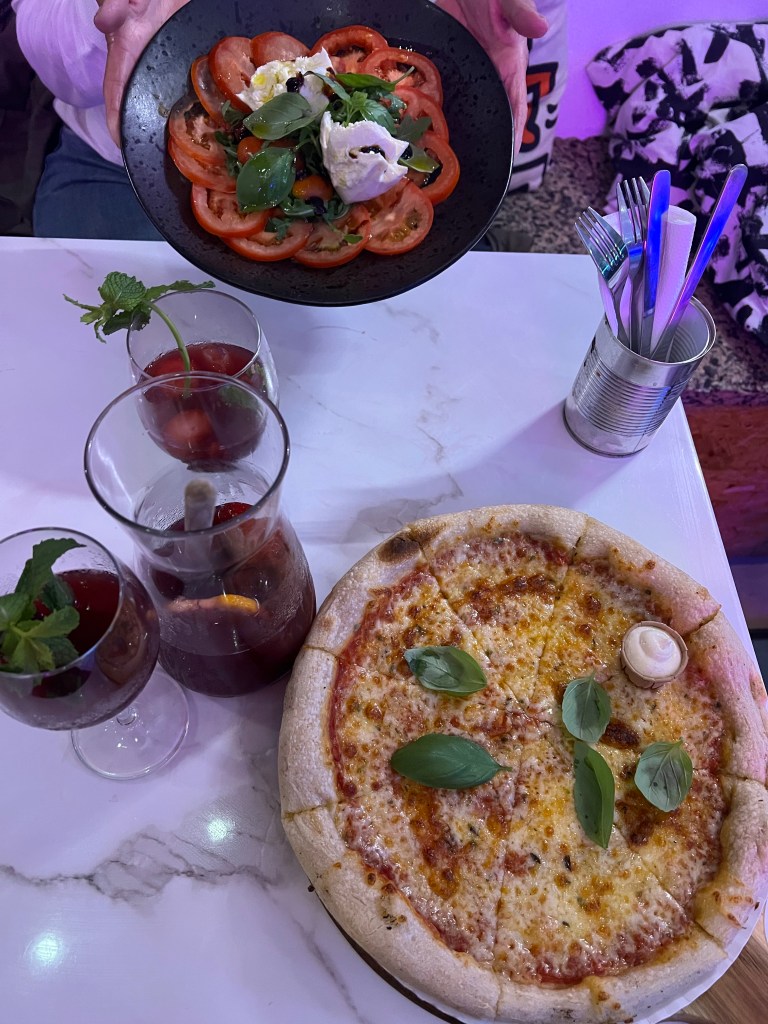
There’s something different about the smells that meat cooking over a fire makes. Perhaps as the meat enters a man’s nose and goes straight to the ancient part of his brain it makes man feel triumphant, confident, masterful and happily satisfied.
Our hike is long over and we’re now rested, clean, napped and reenergized. We then walked into Burgau to Aries, a South African restaurant in town. We started out with the sangria. One can’t go wrong here. Next we were asked if we wanted the bbq chicken to be hot as in spicy or hot as in so strong flavored that it makes one’s internals are now getting a whole can of whoop ass.
The SA (S African) girl server was lovely and chatty with all of us. The restaurant Aria is owned by several South African friends and family members who also make up the founders, the owners and the kitchen staff.

Over the past few days we’ve met some of the most well traveled people in the world. Some of them had come from worlds very similar to the one that Patti and I came from. Everyone was easy and comfortable enough for us to communicate with.
The flavor that we get from traveling comes from only two things. One is their people and the other is their foods. Anthony Bourdain would be proud.
And to think that just yesterday we were aged thirty. The world is still bigger than we now think that it is.
And may you also be blessed on every mile of your present and future travels my love. Dedicated to Patti (My little buddy)
End

 Trawlercat Chronicles