In the annals of American history, the Lewis and Clark expedition of 1805-1807 stands as an enduring testament to the spirit of exploration and the resilience of the human soul.
This epic journey, chronicled in Stephen Ambrose’s “Undaunted Courage,” featured a cast of remarkable characters: Sacajawea, a young Shoshone woman won in a gambling match by a French Canadian trapper; her infant child; York, an enslaved African American owned by one of the expedition’s leaders; and Seaman, a loyal Newfoundland dog.
For over two years, they braved a litany of hardships—mosquitoes, inclement weather, unforgiving terrain, treacherous waters, injuries, starvation, disease, and encounters with hostile Native American tribes—forging a legend that has been etched into the fabric of our nation’s past.
Inspired by this historic odyssey, I, proposed a watercraft ride of monumental proportions in 2022—an adventure that would satiate my twin passions for history and personal watercraft (PWC) riding. What began as a flicker of an idea soon ignited into a full-fledged expedition when Lewis, the founder of the West Coast Watercraft Club, and countless other riders eagerly joined the cause.
Thus, the “Columbia River 500 Miler” was born—a name that, in retrospect, may have been a misnomer, as the journey from Lewiston, Idaho, to the Pacific Ocean spans less than 400 miles. Yet, the moniker stuck, evoking the challenge and allure that captivated our band of intrepid riders.
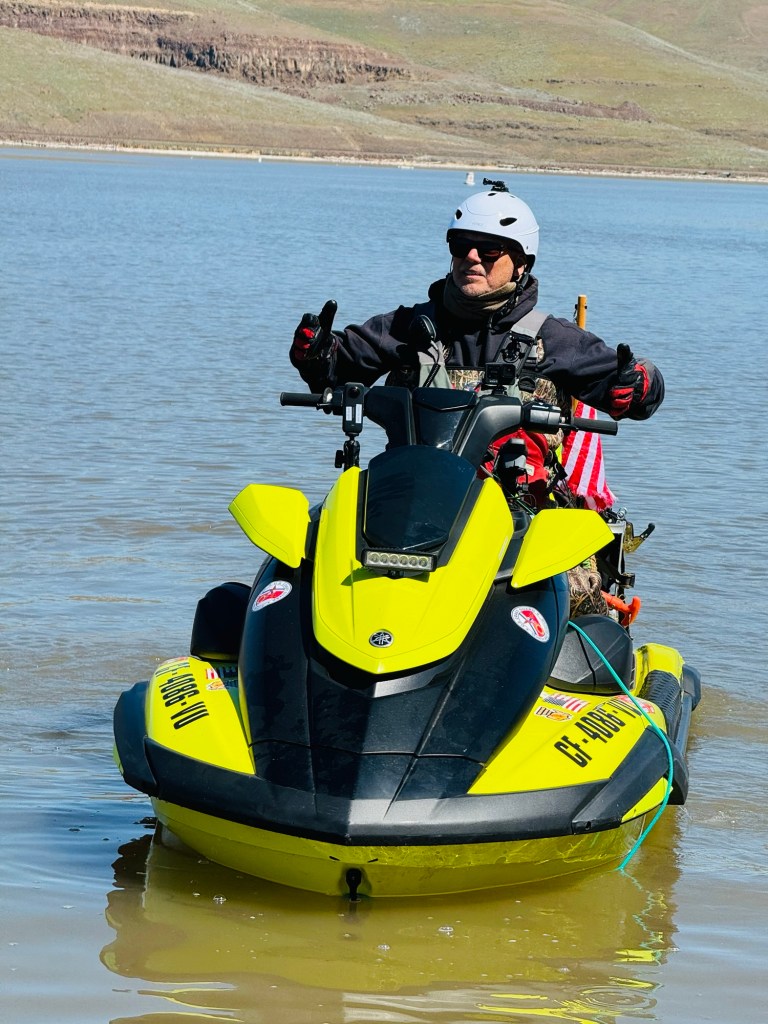
From an initial roster of sixteen, only three riders persevered to undertake this ambitious endeavor: myself, aboard a 2022 Yamaha FXHO; Lewis, piloting a 2022 Sea-Doo RXP 300; and Jeff, commanding a 2017 Kawasaki Ultra 300. Each of us brought our own quirks and idiosyncrasies to the table, a fact that became glaringly apparent despite never meeting in person. Our planning unfolded entirely through the digital corridors of WhatsApp, a testament to the modern conveniences that starkly contrast the rudimentary tools of Lewis and Clark’s era.
Preparing a PWC for such an expedition is an exercise in ingenuity and foresight. These compact vessels proved surprisingly capacious, accommodating an array of essentials: anchoring gear, safety equipment, navigation tools, communication devices, and photography equipment to capture the unfolding saga. As the departure date neared, Amazon deliveries piled up—electric fuel transfer pumps, fuel racks, and other provisions to ensure our crafts and bodies remained fueled for the journey ahead. In today’s world, a smartphone, a GoPro, a credit card, and a substantial cash reserve suffice for most needs, though fuel—for both machine and man—remained the paramount expense.
Organizing the Columbia River 500 Miler required meticulous planning, aided by modern technology and resources. Waterproof maps from Fish N Map Co. became my trusted companions, offering detailed GPS coordinates, launch ramps, and marina locations. These tangible charts allowed me to visualize the scope of our commitment, plotting a course through the man-made waypoints dotting the Snake and Columbia Rivers. Unlike the perilous unknowns faced by Lewis and Clark, we had access to accurate weather forecasts, fuel stop locations, and lodging options—luxuries that rendered our adventure safer than a typical road trip, despite the skepticism of fellow riders.
Our goal was audacious yet simple: to be the first to traverse the Snake and Columbia Rivers from Lewiston, Idaho, to the Pacific Ocean on personal watercraft, crafting our own indelible memories along the way. The Columbia River, originating as a modest trickle in Canada’s Kootenay Mountains, swells into a formidable force, fed by up to 100 tumultuous tributaries over its 1,234-mile course to the sea. Naysayers among the invited riders warned of insurmountable obstacles: insufficient fuel stops amid soaring gas prices, a dozen river locks barring passage, deadly rapids on the Snake River, and ferocious winds exceeding 100 mph in the Columbia River Gorge. Some even predicted the journey would take a year to complete—an echo of the original expedition’s duration.
Undeterred, we set our launch date for August 2022 at Hells Gate Marina in Lewiston, Idaho, aiming to reach the Pacific by touching the borders of Washington and Oregon. Boating season was in full swing, with sunny skies and daytime temperatures in the mid-80s, cooling to the 70s at night. The landscape unfurled in breathtaking splendor, transitioning from the golden wheat fields of the Palouse—producing more wheat per acre than anywhere else globally, with 90% barged downriver—to a vibrant tapestry of evergreens and hardwoods lining the riverbanks. The Snake River Gorge, plunging 7,913 feet over a ten-mile expanse, surpassed even the Grand Canyon in depth, claiming the title of North America’s deepest river gorge.
Our route promised both exhilaration and peril. At Cascade Locks, we would navigate a lift chamber hewn from solid rock, 460 feet long and 90 feet wide—a marvel of engineering dwarfing the challenges of yesteryear. With an average speed of 45 mph, we were equipped to confront the elements—rain, wind, fog, turbulent waters, and, yes, mosquitoes. Yet, unlike Lewis and Clark, our hardships paled in comparison. Their tale, immortalized in “Undaunted Courage,” recounts true adversity; ours was a modern adventure tempered by preparation and technology.
Sadly, our quest was thwarted not by nature’s fury but by an unforeseen foe: COVID-19 struck our group, forcing an abrupt end to the ride. Of the sixteen who initially signed on, only three attempted the journey, and none reached the Columbia River Bar. Why, then, do I share this unfinished story? Perhaps it’s the human impulse to document effort and intent, to preserve the spark of ambition even when the flame flickers out. As Will Rogers quipped, some learn by reading, others by observing, and a rare breed—like us watercraft riders—must “pee on the electric fence” to truly understand.
Would I recommend this ride to others? Unequivocally, yes. More souls have summited Everest or pierced the Earth’s orbit than have conquered this watery path—a statistic I’d love to claim but cannot. The Columbia River 500 Miler is not merely a ride; it’s a crucible for the spirit, a chance to harness the surplus energy and curiosity that define youth—energy that doesn’t accrue with age but atrophies if unspent. Life, after all, demands we feed it until the end.
And so, I leave you with a nod to history’s unsung heroine: Sacajawea, born circa 1788 in Idaho’s Lemhi County, daughter of a Shoshone chief. Captured at twelve by the Hidatsa, she trekked 500 miles to North Dakota, only to join Lewis and Clark at sixteen as their Shoshone interpreter, infant in tow. Her visage graces a U.S. stamp and the one-dollar coin—a quiet tribute to a girl who shaped a nation’s destiny.
The actual ride was accomplished in 2024 by Roberto, Todd, Billy and myself.
Trawlercat
August 2022


 Trawlercat Chronicles