A group of five of us—retired firefighters and myself—rolled out toward the Goat Canyon Trestle, drawn by that raw mix of desert solitude and forgotten railroad grit. We started strong from the Jacumba area, parking near DeAnza Springs Resort or a pullout off Carrizo Gorge Road for easy access to the old rail grade.
The miles piled on, the heat pressed in, and the obstacles thinned the group. Only my buddy Terry and I pushed all the way to the trestle and back. Respect to Tracy, Tony, and Jim, a few things came up that didn’t allow them to complete the trek with us this time.
We’ll get our hose of firefighters 🔥🚒 (Because they’re always ready to lay down some line!) back together at a later date and all come do this together and maybe, just maybe we can also give rail bikes a try.
Mountain bikes or e-bikes turn the old Carrizo Gorge railroad grade into a viable approach for us Emeritus retirees; mostly gentle rolling miles along the abandoned tracks, cutting through tunnels and over smaller trestles, letting you cover ground efficiently while the eerie quiet of the badlands sinks in—just 15 miles shy of the Mexican border.
Built in 1933 after a tunnel collapse crippled the San Diego & Arizona Eastern Railway (the line folks once dubbed impossible), the Goat Canyon Trestle is a beast: roughly 600–750 feet long, towering about 186–200 feet high, the world’s largest freestanding all-wood trestle, constructed from redwood to handle the canyon’s wild temperature swings without metal fatigue. It’s endured nearly a century in this isolation, a silent monument to old-school engineering know-how.
The men who built it? Thousands of unsung laborers—mostly immigrant workers (including Mexican, Chinese, and others common to era rail projects)—did the backbreaking work with picks, shovels, dynamite, mules, and sheer endurance in remote desert camps.
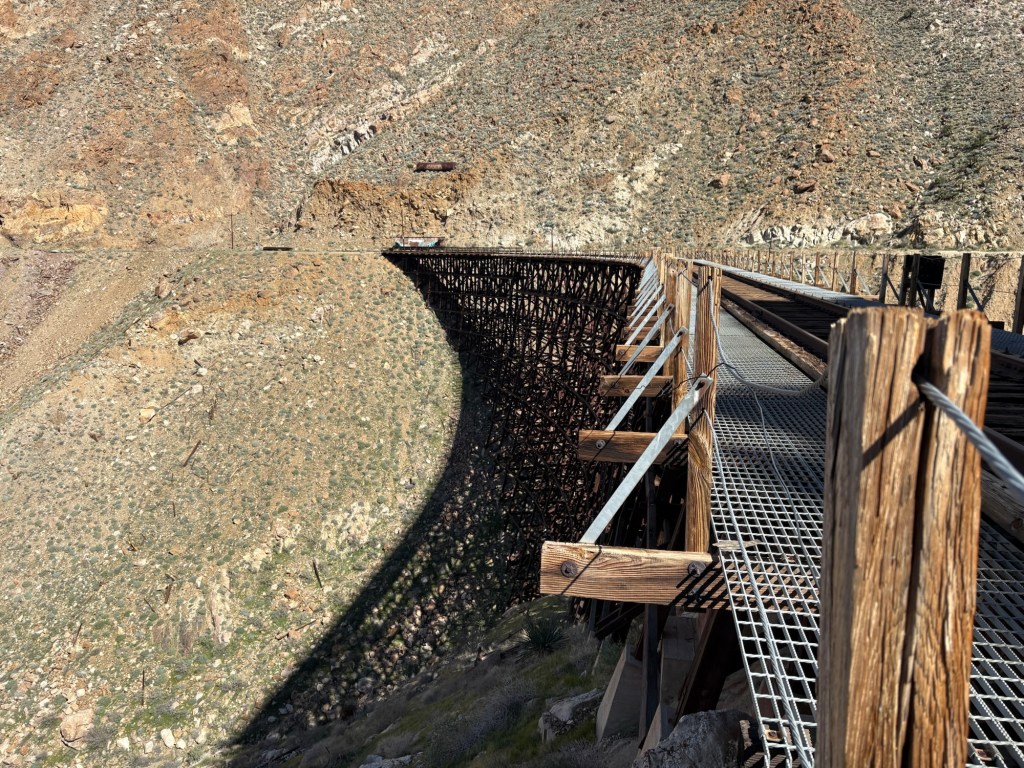
The ride follows the abandoned rail bed—mostly flat or gently downhill outbound, with only about 700 feet of subtle elevation change across a longer out-and-back (railroad grades keep it imperceptible). You’ll pedal through 10–15 tunnels (headlamps essential; many are dark, curved, partially collapsed, or littered with debris). Cross smaller trestles, dodge rock slides, and thread narrow ledges with sheer drops—stay sharp, pick clean lines, because there’s zero margin for error where the path hugs the canyon edge.
The first tunnel hits you right away: a locked metal gate that won’t budge, no visible lock mechanism, just a stubborn slide bar that teases but doesn’t give. Terry wrestled with it for half an hour, convinced it was some puzzle he could crack—turns out the workaround is a steep side trail that climbs up and around to the left, with a brutal sheer drop if you misjudge your footing or tire placement.
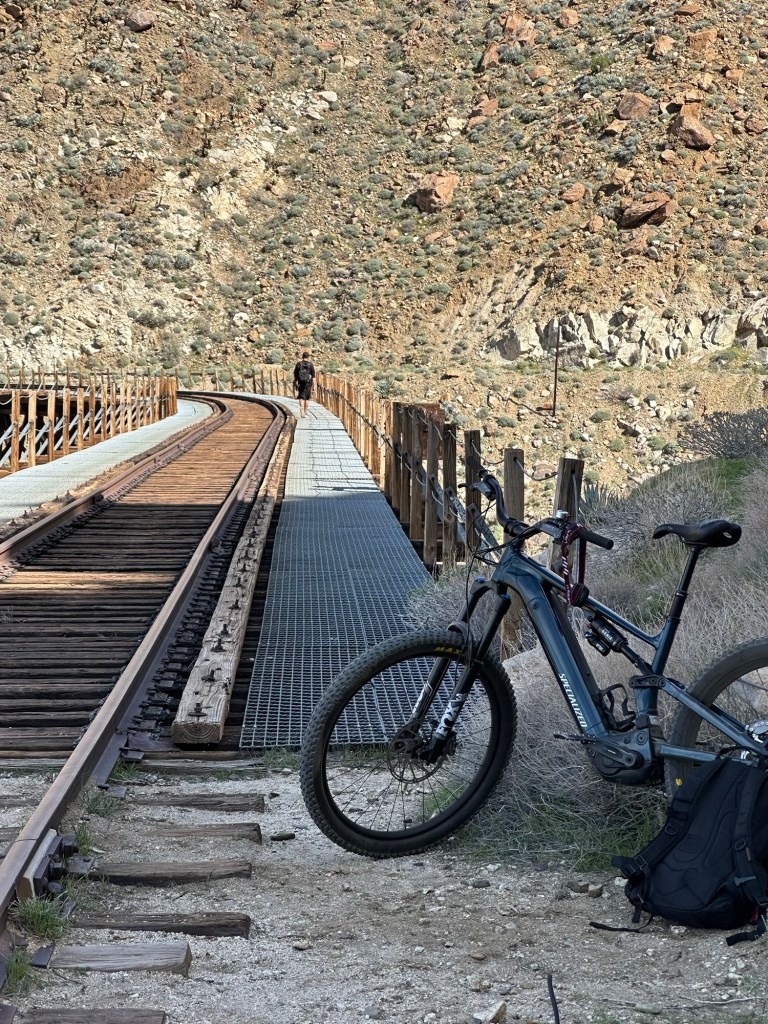
Heavy e-bikes like my Magician Atlas make those detours punishing; count on lifting and muscling your rig over rocks, debris, and collapsed sections countless times—especially frustrating on the return when fatigue sets in. I kid you not. This ride took it all out of me. Like an ebike on zero power mode.
Cholla cactus lurks everywhere, right off the trail, spines ready to punish any brush. One section had a whole ball of it glued to my front tire. Another time, I stabbed into a bush that left my left grip covered in spines piercing straight through my gloves into skin. Picture yanking those out one by one while your bike’s tipped on an incline—every pulled spine sticks to the opposite hand, turning a quick fix into a slow torture.
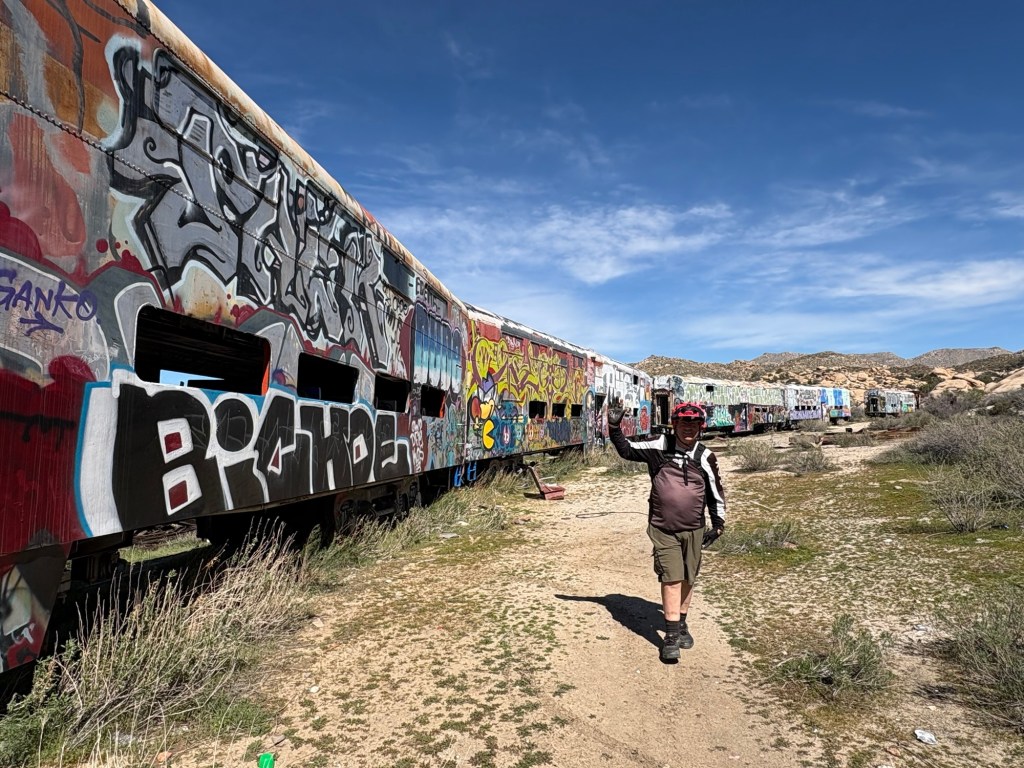
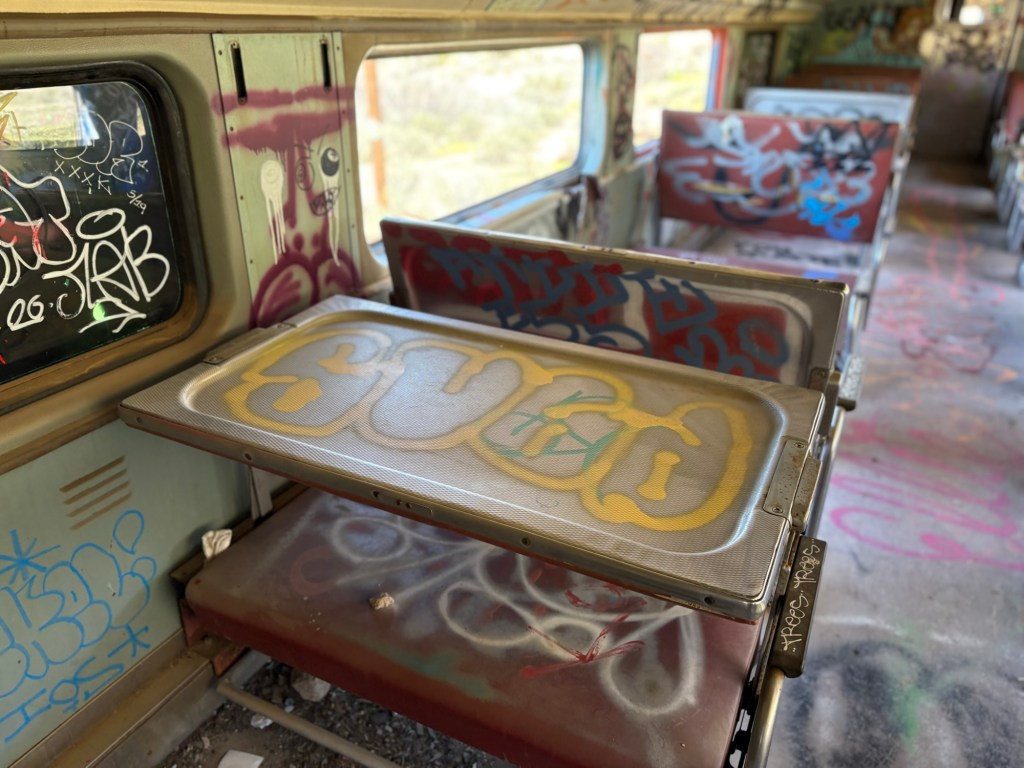
Expect frequent dismounts to lift the bike over rock falls, debris piles, rail tracks or sketchy spots—no massive carries, but the cumulative hassle adds up. Abandoned railcars covered in graffiti sit like ghosts along the way, adding to the vibe. The final push delivers you to the Goat Canyon Trestle itself—stand on the span if you dare (mind posted signs; sections are private property, and trespassing can draw heat). Missing planks in places mean extra caution; if wind kicks up (it did for a brief stretch), steady hands are non-negotiable—gusts across that height feel amplified.
This wasn’t some leisurely cruise through the hills—it was a calculated, high-stakes operation, a razor-edge mission demanding flawless execution just to get in and out alive.
We plotted every line, every exposure, every bailout point like a military op. One wrong move, one twitch of hesitation, and the consequences were catastrophic: sheer drops plunging hundreds of feet into jagged canyons below, loose shale that could send your bike—and you—cartwheeling into oblivion, and exposure so relentless that a single lapse in focus meant vertigo turning your stomach inside out and freezing you mid-pedal stroke on a knife-edge traverse.
If you suffer from vertigo, dread heights, possess anything less than expert-level mountain bike skills, or can’t stomach real, pulse-pounding risk where death is a legitimate possibility, do not even think about attempting this. This trail doesn’t forgive; it punishes.
And then there are the rattlers. None struck at us that day—luck, sharp eyes, or maybe they just weren’t hungry—but the place is absolutely infested with them. Those forgotten water tanks and tapped springs from the steam-locomotive era still seep life-giving moisture into the parched rock, turning them into deadly oases. Snakes coil in the shade, sun themselves on the trail, strike without warning when a tire rolls too close or a foot lands wrong. One bite out here, miles from help, and you’re racing the clock against neurotoxic venom that can shut you down fast—swelling, necrosis, organ failure—if you even make it off the mountain.
This wasn’t adventure.
This was survival.
And we pulled it off.
Barely.
No shade anywhere, blazing sun year-round (even late February scorched us with that dry, thin air). We packed plenty of water (at least three liters each), sunscreen, offline maps, and GPS—signal vanishes quick, and wrong turns out here can and do bite hard. Tunnels give fleeting cool relief, but the return grinds subtly uphill under that relentless hammer of dry desert heat.
Get caught unprepared, push sketchy sections too hard, or ignore the warnings, and it’s all on you.
But, once you finally roll up to that massive wooden span, your bike tires on a century old weathered redwood, railway history humming beneath you—there’s a deep final satisfaction in the miles you just conquered.
A quiet nod to what’s possible when you keep pedaling forward. We kept our nose to the grindstone, knowing the boys were anticipating a robust trip report.
That ride was yesterday. Terry and I texted this morning, still buzzing from the high. My arms are burning, the bike’s waiting for a wash, flat fix, seat tighten, and a proper video edit. For years we’d talked about this as a bucket-list item. Now it’s checked—raw, tough, and worth every lift, spin, and drop.
Trawlercat 2/26/2026
Photos and story by Terry and Ralph

 Trawlercat Chronicles
Great write up. About 40 to 45 years more or less ago, I took my son with a group on a camping trip through Carrizzo gorge. I strongly remember the singing of the rattlers from all directions. MY son was less than 10 at the time and I had to carry his pack as he was tired and I was protective. It was a fond memory. Thanks for reminding me. warmest regards
Steve
LikeLiked by 1 person
Exiting day. So close yet so far, you would never know you are so close to San Diego
LikeLiked by 1 person