Vietnam’s Northern Veil: A Gentle Wander in Lào Cai
Days 5/6 – Saturday, 11:11 a.m.
Ten of us slipped into Lào Cai Province on motorbikes—some brand-new, others just broken in—Kim up front, calm as a monk, threading us through the sharp morning light like he’d drawn the map himself. This ride or story isn’t about any single rider. It’s about the pack. Us. And Jason—Tu to the locals—who could diagnose a misfire by ear and fix it with a cigarette dangling from his lip; Xuan, the media guy with a GoPro grafted to his helmet and a digital camera with a wide lens, always angling around us for the money shot; Hai, steering the support van with the quiet confidence of a man who’d driven worse roads in his sleep; and Thom, the trucker, who doesn’t yet speak a word of English, but I’m working on it. Joe and Matt? They were in the van too, feet up, trading stories, and letting the mountains come to them.
This is Kim’s home ground now. We came to this area for the thin blue ribbon on the map—the river that separates here from there—and for the ache of seeing China on the far bank, close enough to touch if the world were a little kinder.
Lào Cai (often rendered “Lao Cai” in English) spans a province and its namesake capital in Vietnam’s northwest, brushing Yunnan Province in China.
Its weight in time comes from sitting astride a vital border gate, steering trade, battles, migrations, and cultures for more than a thousand years.
The Old Road
Long before borders were inked, feet wore these trails. Silk, salt, horses—river-shy goods—climbed ridges on human or mule backs. Hmong, Tay, Dao ignored far-off thrones. Their chiefs bargained softly with taxmen from Chinese dynasties or Ming legions alike—gifts eased the way.
Today we traced those back lanes, watching ancient paths widen into paved arteries. Crews and machines hummed everywhere, layers of progress stacking up.
A girl herded the biggest water buffalo yet—swollen, I’d wager, with calf. She grinned, hands occupied, no wave needed. The trail knew us both, and would outlast us.
French boots arrived with rifles; and by 1886 they raised their flag at the river’s crook, dubbing it “strategic.” Then the railway—1,000 km of iron was built from Hanoi to Kunming.
The 1902 bridge, riveted and hopeful, ferried opium south, canned goods north. Villas rose, a customs post, a hotel where officers sipped pastis and swapped weather tales.
The first span of the bridge fell to Chinese blasts after the 1979 Cambodia invasion, but its successor keeps the name.
War, Again
Viet Minh slipped Chinese rifles along the tracks and by 1950 they claimed the town under torchlight by the river. The French pulled back, lines cut, ambitions stalled.
Three decades on, Chinese tanks returned. Shells rained on the town for weeks; silence and rubble remained.
Near the market today, an elder said to me in broken English. “Caves hid us,” ash tapping on the ground, even the dogs vanished.” He shrugged. Some tales stand plain.
The New Bridge – Rebuilt in the ’90s. The Hekou–Lào Cai gate swung open in 1993—handshakes, wary grins. Trade seeped, then surged. Vietnam’s busiest land port: Mekong durian north, iPhone bits south.
We couldn’t cross—re-entry hassles—so we observed. Chinese side: a billboard touting “Harmonious Border Trade.” Vietnamese side: women peddling dried goods.
The Sa Pa Detour: Thirty Kilometers Up the Hill
Skip Sa Pa near Lào Cai? Unthinkable. Just 30 km, but the road twists upward defiantly—hairpins veiled in fog, visibility to the second bike ahead.
French hill stations first claimed it as Hanoi heat relief. Now hotels, homestays, massage spots crowd in; Hmong in indigo hawk crafts.
We departed Sa Pa, paused at the bridge for photos, then hugged the eastern ridges north to Bắc Hà’s Sunday market.
Earlier, at the border halt, a sun-etched woman sold me tiny “dried apples” in plastic—cherry-tomato-sized, pomegranate-red, pitted hard. No apples. I paid the curiosity toll, shared the bag. Riders sampled, chewed, nodded.
By mid-afternoon we reached Bắc Hà District, Lào Cai. Air thick with holiday spice.
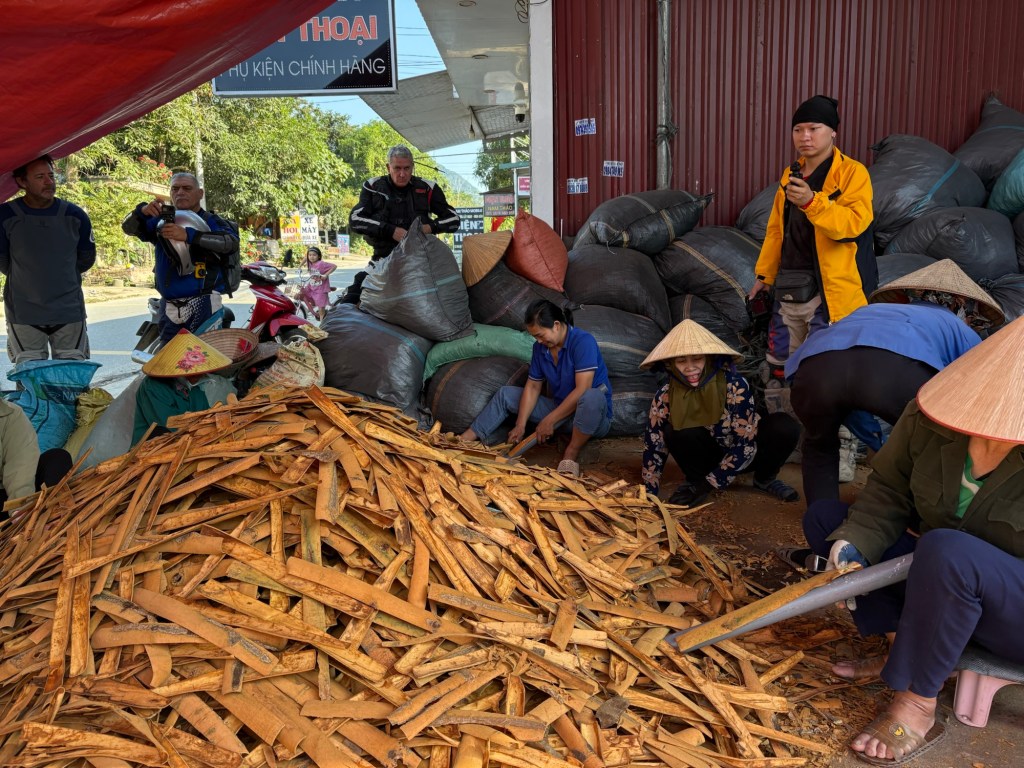
In a low-roofed shed, eight women peeled in steady cadence. Fresh cinnamon logs—straight, pale—piled like cords. Cross-legged on floor or stool, curved blades spiraled bark into damp ribbons curling like scrolls.
Shh-thunk, shh-thunk. The aroma rolled in—sweet, piercing, undeniable.
One, around age forty, glanced up, smiled. “Try?” likely in Vietnamese.
I offered the mystery fruit. “Dried apples.” She bit, bag circling—tastes, nods, passes.
We eyed the peeling; they eyed us. Silent exchange. Then Joe and Bill, our morale, welfare and recreation duo, unveiled at least two dozen drumstick ice creams, frost-kissed from a village cooler.
Eyes lit. Cones followed the fruit’s path. Laughter spilled—sticky hands, vanilla melt, cinnamon flecks on mouths.
Neighbor kids claimed leftovers. Peeling paused, dripping continued; ten minutes of pure pause.
Borders are just map scratches, Geography just funnels what we hurl: silk, shells, durian, odd fruit, or women’s quiet craft sharing melted sweets with passersby.
Lào Cai doesn’t demand you note its wounds.
Day 6 – The Unscripted Stop
We stopped, and the time now is 11:11 a.m. I had to look because I forget what day this is, what day of the week it is, or how long we’ve been on this ride.
Today is Saturday. Six of our nine-day ride in Vietnam are behind us; the group is gelling really well. Anyone who wants to ride up ahead does so on a rotating basis.
Some prefer the view and pleasure from the middle or rear of the group. From this vantage point, one can truly see the whole smiles of the kids whose hands we just slapped or the candy they are now picking up.
We’re in an unscripted town, all of us having some sort of coffee—Chris, our Brit, is having tea.
Two women run the place. One wears an altered Hồi giáo shirt—bright, proud—and the walls bloom with framed photos: her son, her daughter, grandkids, a beautiful display.
Two pictures of Ho Chi Minh. Ho Chi Minh (1890–1969) was the revolutionary who led Vietnam to independence from French colonial rule and became the founding father of modern, unified Vietnam.
His real name was Nguyễn Sinh Cung; he used more than 50 aliases in his lifetime, but “Ho Chi Minh” (“He Who Enlightens”) is the one that stuck after 1942.
Very welcoming. Large parking area out front; she probably has overseas relatives supporting the venture.
Kim usually selects the spot. Sometimes we go straight to lunch; today it’s coffee, which means lunch will be late.
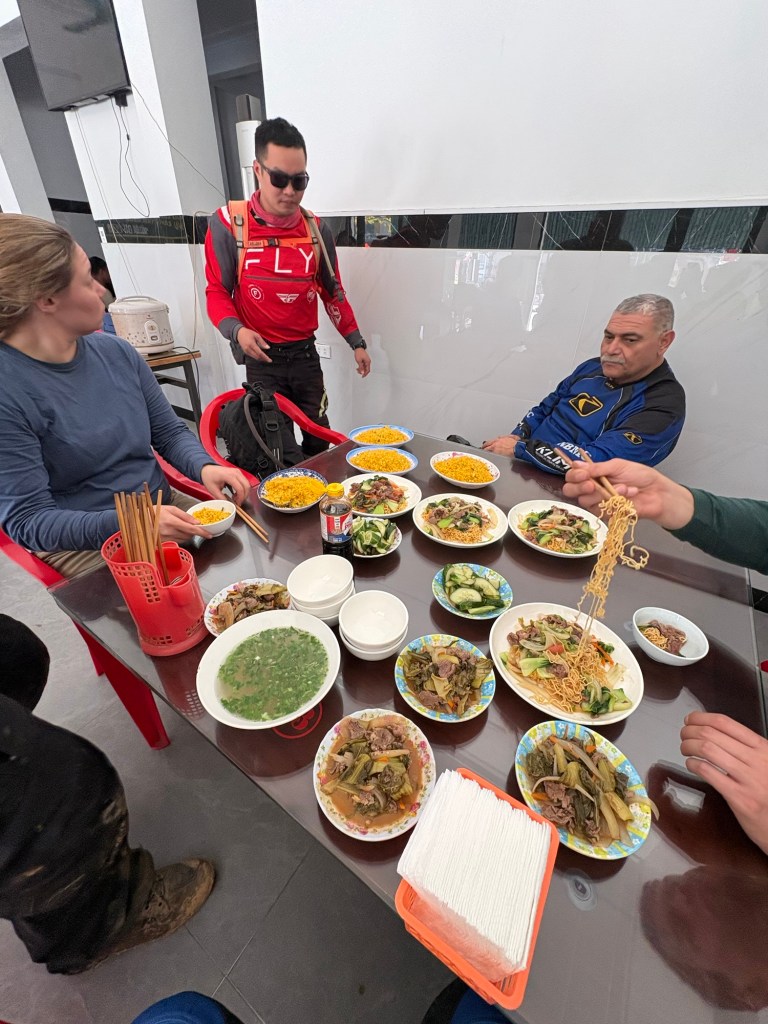
So far, lunches have been good to great—the last two a 9.5 and a 10 on any scale. Dinner last night was excellent: Kim promised a “good surprise,” a flaming dish. It turned out to be banana coated with rum, lit up at the table—one of the best bananas I’ve ever had.
Earlier we came down the hill. All of it was twisties, but before that was incredible: we literally crested the mountainside—nice broken red rock, lots of mud. A truck harvesting cinnamon trees was stuck axle-deep in the road. We weaved around him.
Then somebody got the right idea: let’s get the truck unstuck! Rally a few locals, and together we can rock the truck free. Great idea but, an impossible execution.
The driver grinned, waved us through like old friends. The scent of fresh-cut cinnamon clung to our jackets for miles. We roll on. The veil lifts a little more with every bend.
And just now, as I’m finishing up the story, one of our guides brings me over an avocado milkshake and asks if I would like one. I said, “Oh my God, outstanding compared to the coffee,” which is strong but not like the first day where we had coconut coffee or salted coffee—that isn’t an option here—so I took the milkshake, and it is just a blessing in disguise: delicious.
Earlier, up ahead in front of me was Kim the guide on the twisties coming down. We have two riders named Chris, one of whom is a rockstar. Jose was up ahead, and so was Matt. These are the guys who like to ride toward the front, and so do I, but if you hesitate for a second, you’ll easily find yourself at the rear of the pack.
On another ride, I trailed behind Jeffrey. At one point, a tiny kid—no more than two feet tall, maybe three or four years old—stood right at the roadside, staring up at us with wide eyes. Jeffrey slowed, then stopped his bike entirely. He leaned down, coaxing the child into a gentle high-five, slipped a piece of candy into the small hand, and pedaled off with a grin.
I rolled past next, reaching out for my own slap. The kid froze for a split second, then burst into delighted laughter, arms flailing outward in pure joy—before spinning away in a fit of bashful giggles. It was one of those fleeting, heart-melting moments no photo could ever capture; words are all I have left of it.
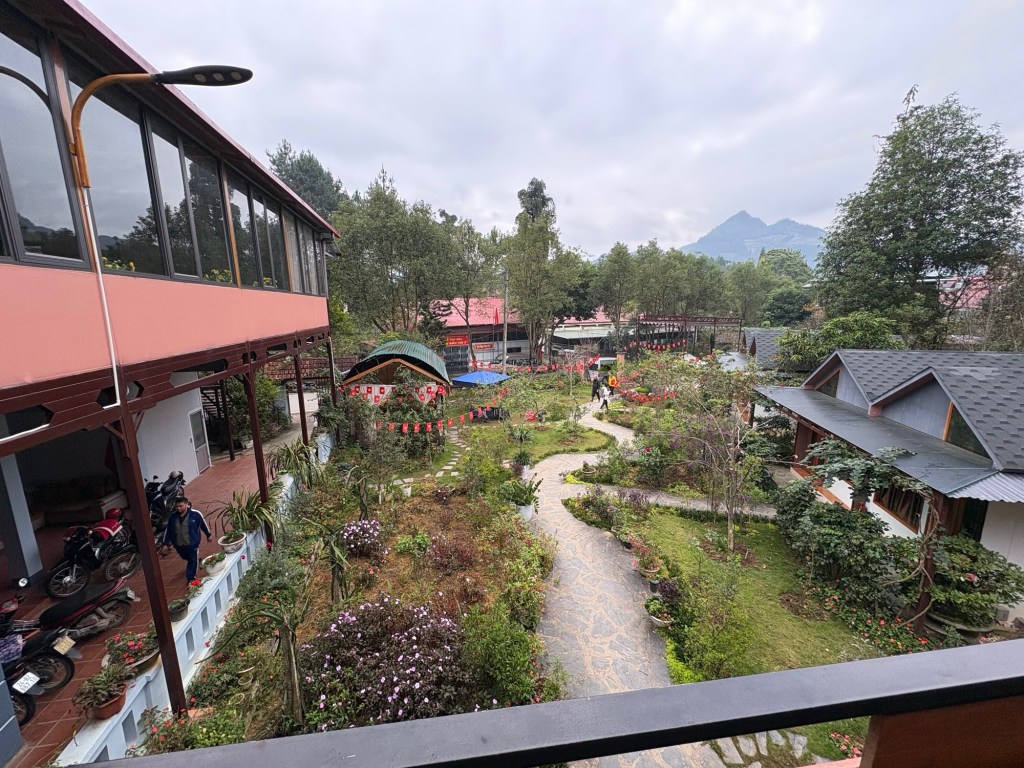
And just about an hour ago we arrived at our (Day 6) lodging called the Khách Sạn Thắng Sen or at least that’s what is shown on the map.
Na Han Province (Vietnamese: Tỉnh Na Han) is one of Vietnam’s 58 provinces, located in the northeast region of the country, bordering China to the north. It was officially established on January 1, 2025, through the merger of Cao Bằng Province and Hà Giang Province.
The night is still young. There’s food at 7:00 PM and hopefully a massage before bedtime. And that my friends is a full day that my older self can look back on and say wow, what a ride!
“Life should not be a journey to the grave with the intention of arriving safely in a pretty and well-preserved body, but rather to skid in broadside in a cloud of smoke, thoroughly used up, totally worn out, and loudly proclaiming ‘Wow—what a ride!’”
— Hunter S. Thompson
Ralph

 Trawlercat Chronicles