The bus now hums along like a soft cradle, rocking me gently in my little pod on the upper deck of this HK Open Tour sleeper. It’s no fancy limo, just a reliable Vietnamese workhorse run by a Hanoi outfit that gets backpackers up to the mountains without the usual aches. I’m stretched out in a VIP berth—about four feet wide, six long—perfect for my average build. Taller folks might curl up a bit, but hey, it beats cramming into a van or a plane seat.

There’s a quiet massage function buzzing now at a low setting, like a friendly pat on my butt and back. A small TV I ignore, some plugs for charging, a spot for two water bottles, and shelves for a snack or two. Curtains can be moved up or down, the air’s cooled to a comfy chill, and it all feels like a private nook on the move.
First time on one of these buses; as we leave Hanoi behind for Sapa, the weather is rainy. For a 500 miler or more trip, this edges out flying. The lower level might steady the stomach if you’re prone to sway, but up here, it’s just easy drifting.

John Lennon’s voice drifts in through my earbuds—“I’m just sitting here watching the wheels go round and round…” That tune from 1980, written when he stepped back from the spotlight for simpler days with his family. I don’t now like to think how some lost soul took it upon himself to take him away from us.
This ride is up a smooth new highway—built back in 2014, cutting the trip from a bumpy ten hours to around five or six.

John Lennon’s words settle in: folks back home chasing their busy lives, while I’m here, tuning out all noise to head for quiet hills and old paths.
It’s not as easy if you’re not in decent shape. Most activities in Sapa and the surrounding valleys involve a fair bit of hiking and climbing. That might explain why I rarely spot American retirees here.

At lunch today I met two fascinating women from Corsica—Laurene and Emelle (hi, if you’re reading this!). I also had a Polish traveler nearly choke on her phở when I mentioned that back home, a Motel 6 stay often comes with complimentary bedbugs and Prostitutes.

No hurry now—just the steady hum of tires on wet asphalt, pulling me into a slower rhythm I’ve fully settled into on my second day. There’s space here to let the babel of foreign voices fade into white noise. My mind has adjusted; it’s quieter than it’s been in years.
Three times already: “Traveling alone?”
After the second, I settled on an answer: “No—I’ve got Me, Myself, and I.”
Me is the younger version of myself, wide-eyed and unburdened. Myself is his extraordinary wife, Patti—beautiful, complete, and currently back home spoiling grandkids who still reach for her hand.
Foggy rain slips past the curtain as the view dissolves from city sprawl to patchwork fields, then climbs into the granite embrace of the Hoàng Liên Son range.
And the real miracle of Vietnam? The bus drivers. The way they thread these cliff-hugging roads through chaos—motorbikes, water buffalo, monsoon runoff—without raising their pulse or anyone else’s is nothing short of wizardry.
Sapa appears like a cozy highland hideaway at about 1,600 meters—once an escape spot for those French colonials in the early 1900s, dodging the lowland heat. I point my camera and nearly everything around is a photo worthy of framing.
The French set up villas and a stone church that still anchors the town square. Wars in the mid-century knocked travelers down. Things stayed quiet until the 1990s. In the early 1990s, Vietnam’s Communist Party retained one-party rule while accelerating Đổi Mới reforms (started 1986) toward a market economy.
The 1991 Soviet collapse forced trade redirection to Asia and the West. Key moves: normalized ties with China (1991) and the U.S. (1995), joined ASEAN (1995).
Communism politically endured; but economically, it blended well with capitalism.
Now, with the highway and a cable car to Fansipan’s peak (over 3,000 meters), it draws walkers and people like me.
As we descend back into Sapa, I’m wrapping up this story. The Chinese women and their guide are laughing and giggling—the youngest of the three tousling her hair and fiddling with her Louis Vuitton glasses. All of them are made up to the nines… for a hike?
The mist still clings to the air, but we’re holding out for clearer skies, even as a typhoon barrels our way.
As I climbed the endless granite steps to Fansipan Peak—each one carved shallow and narrow, more suited to the lighter tread of Asian feet.
Yet in that discomfort lay a lesson in anatta: no fixed self, only the shifting balance of body and breath. With metta for the ancient builders and patience for my own stumbling, I followed the path upward, one mindful, oversized step at a time, toward the impermanent summit and the vast, silent sky.
Location: Early on November 4 (Philippine time), the typhoon’s center is now in the Sulu Sea, about 430 km east of Guiuan in Eastern Samar, Philippines, moving west-northwest at 20–25 mph. Winds are at 118–149 mph with gusts up 185 km/h.
We pull in around noon and I am shuttled to my hotel. I shake off the ride, soon lunch is served The town climbs in layers: the old church in the center, Ham Rong hill for overlooks.
But it’s the people who stand out—mostly ethnic groups like the Black H’mong in their dyed skirts and silver jewelry, the Red Dao with bright headscarves selling herbs. Tay and Giay villages dot the slopes with stilt houses.
The place is now alive with dried meats, corn wine, and fresh greens. I pick up a small embroidered piece directly from a maker to give to (Myself) keeping in mind to support the locals.
My first day here after a 10k hike and I decide on a Rolfing session. I’ve so far carried the weight of my years on my shoulders, hip and strong legs —subtle aches from old hikes, a posture that’s softened like well-worn leather.
After our tour led hike I see a massage sign and quietly abandon the group.
Inside, the spa is simple: faint scent of lemongrass oil. No one speaks more than a few words of English, but the practitioner assigned to me Thuy—a tiny calm woman in her late forties with strong, steady hands—pulls out her iPhone translator. I can’t help but admire her hair.
The two-block crop that she is sporting softens up her femininity. The sides and back are tapered high giving her that feather outward appearance for bounce and texture. Low-maintenance yet chic, I should know; I am the poster boy for low maintenance appearance and wear. The style frames her face nicely.
We pass the phone back and forth like it was a quiet game.
I remain in my bamboo underwear recently purchased at a tourist bus stop and the rolling session begins on my upper neck. It’s brutal at first but then it just gets less brutal.
She should adjust her technique for seniors like me, myself or I—gentler, mindful of bones but, NO.
No music at all in the room and bright overhead lights like in a surgical room; it’s so cold that I actually start trembling when Thuy removes the blanket to add more lotion or potions and then the process continues.
She uses slow, deliberate pressure—fingers, knuckles, elbows—sinking into tight bands around my ribs, pelvis, the long line of my back. It’s not a spa massage; it’s deep, and it hurts. sometimes sharp, like pressing a bruise that’s ready to let go.
“Breathe,” I say to myself. The fascia yields in small waves, a quiet unwinding. For someone my age, the payoff is real.
Pain that’s lived in the hips for decades eases as connective tissue lengthens, letting movement flow instead of fight. Posture lifts—shoulders settle back, spine finds its quiet curve, and I stand a little taller without trying. And best of all the climbing that I did today feels effortless or I least I tell myself.
Balance steadies; the body remembers how to meet the ground with confidence, useful on uneven village paths or slick bus steps.
Flexibility returns in increments—reaching, bending, walking—less effort, more grace. It’s not instant, but one session plants the seed: the body, like the mind, can still loosen its grip.
I walk out lighter, the mist cooler on my skin, the valley air sharper in my lungs.
The translator chirps a final message: “Come back tomorrow. Body listens slow.” I smile, nod. In Sapa’s hush, even silence speaks clearly.
Mid-morning, I set off on a trek through Muong Hoa Valley—nothing too strenuous, just a day’s walk.
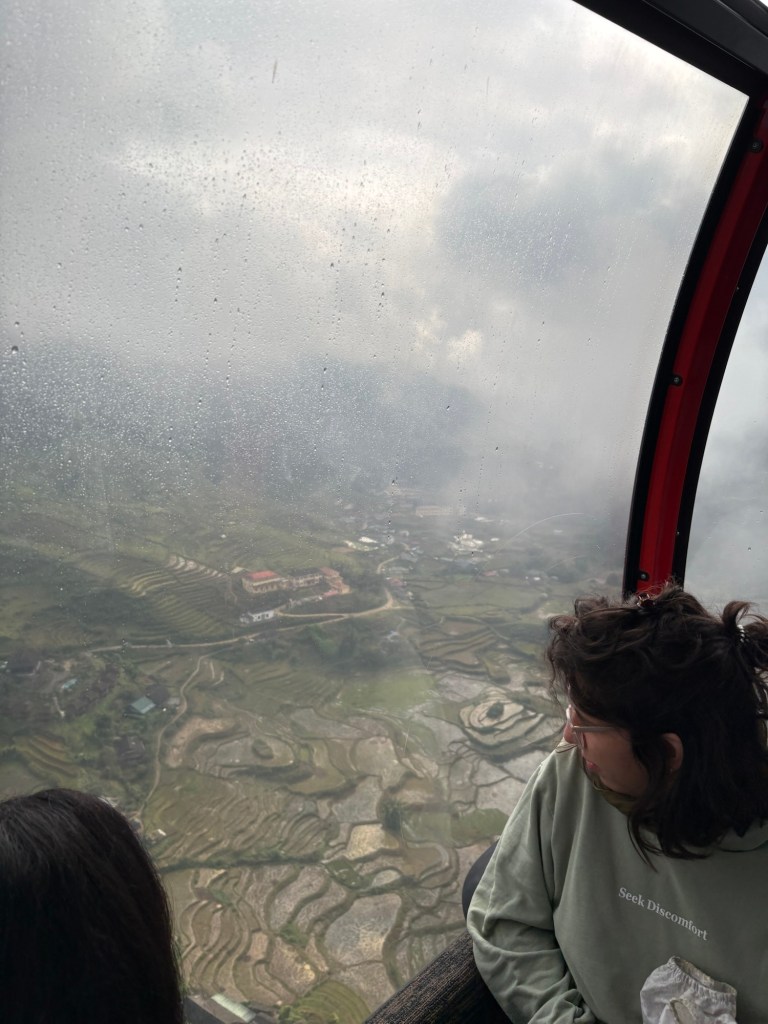
It dips from town into Cat Cat, with streams and lazy buffalo in the fields. The rice terraces step down the hillsides like green waves, lush from May to September, golden come harvest.
Tomorrow maybe I will walk across bamboo bridges, pass a waterfall near O Quy Ho Pass, and reach spots with views far out. There are longer treks to villages like Lao Chai, but this suits fine—fresh air, steady steps.
Sun lowering, I settle back down at a homestay in Ta Van, a Giay spot—simple wooden house on stilts, netted bed facing the valley, about $15 with meals.
Dinner’s shared on the floor: grilled meats, sticky rice in bamboo, foraged veggies, a sip of corn liquor. The family’s warm, no Wi-Fi pulling attention.
In a world full of social media, it’s a natural break.
Buddhism talks about letting go of attachments—clinging to things that don’t last, like endless online checks.
Here, it feels practical: notice the pull, but step back. Trails help—breathing with the path, mist reminding everything changes.
Social feeds can twist how we see ourselves, but out here, it’s the real stuff: dirt on boots, a shared laugh.
Next days ease by: cable car to Fansipan for wide views, peaks and clouds below. A pass with twisty roads, better admired from the bus. Market evenings with songs and snacks.
November’s crisp, fields quiet post-harvest, flowers along the way.
Like I said earlier; a Typhoon Kalmaegi is building strength in the Sulu Sea, heading west-northwest.
It’ll cross into the East Sea (formerly the South China Sea) soon, potentially hitting central Vietnam around November 7–9, with strong winds and heavy rain forecast for areas like Da Nang to Khanh Hoa. Sapa’s up north, so direct impact seems low, but check updates—roads could close, or rain swell rivers.
Sapa’s a gentle nudge to slow down, watch the world turn without spinning with it. The wheels go on—tires, water in terraces, daily life—but pausing here feels right. As the hills fade, it’s just a quiet exhale, rolling easy.
Ralph
5/11/2025

 Trawlercat Chronicles