Hanoi – A City That Remembers
I’ve been here for nearly two weeks, moving gently from one guided day to the next by My Lee, the Customer Service Manager at the La Beaute Boutique Hotel and Spa that makes it all happen
It’s the tourist rhythm: arrive, join a group, listen, learn, and move on. It’s structured, yes, but it feels right—spreading support to local families, drivers, and guides while giving a stranger like me a way to see more than I ever could alone.
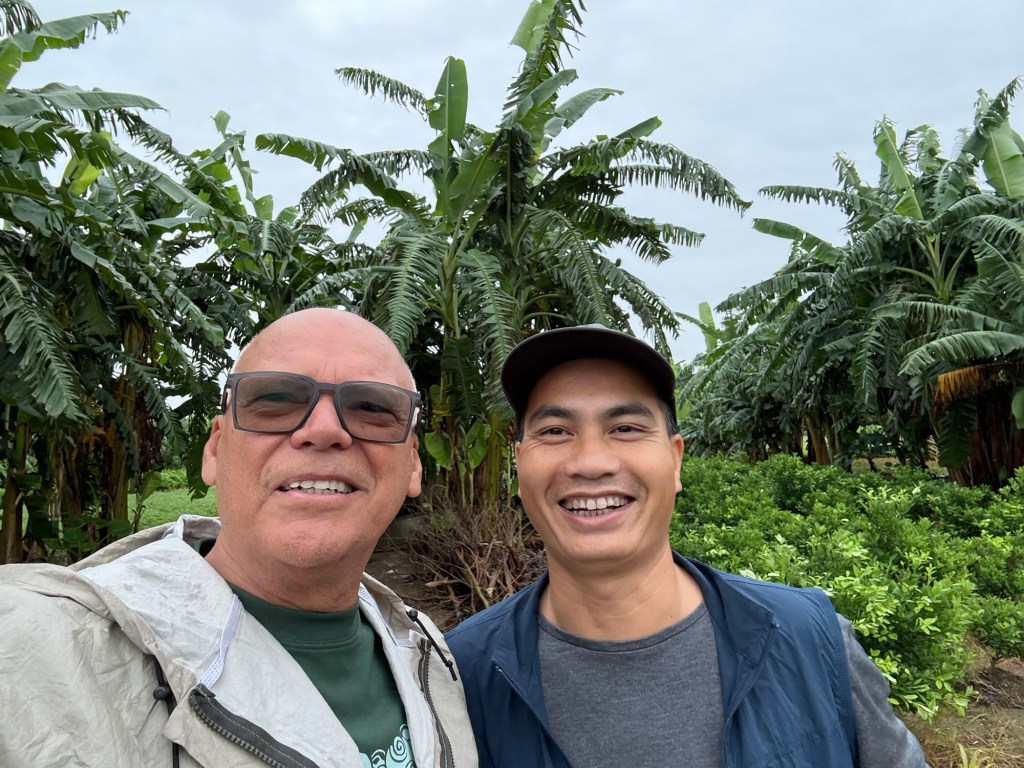
Today we rode in an old UAZ-469 jeep, the same model left over from another era. We passed the Ho Chi Minh Mausoleum in silence, then visited a small farm on Banana Island. Later, we stopped at Huu Tiep Lake.
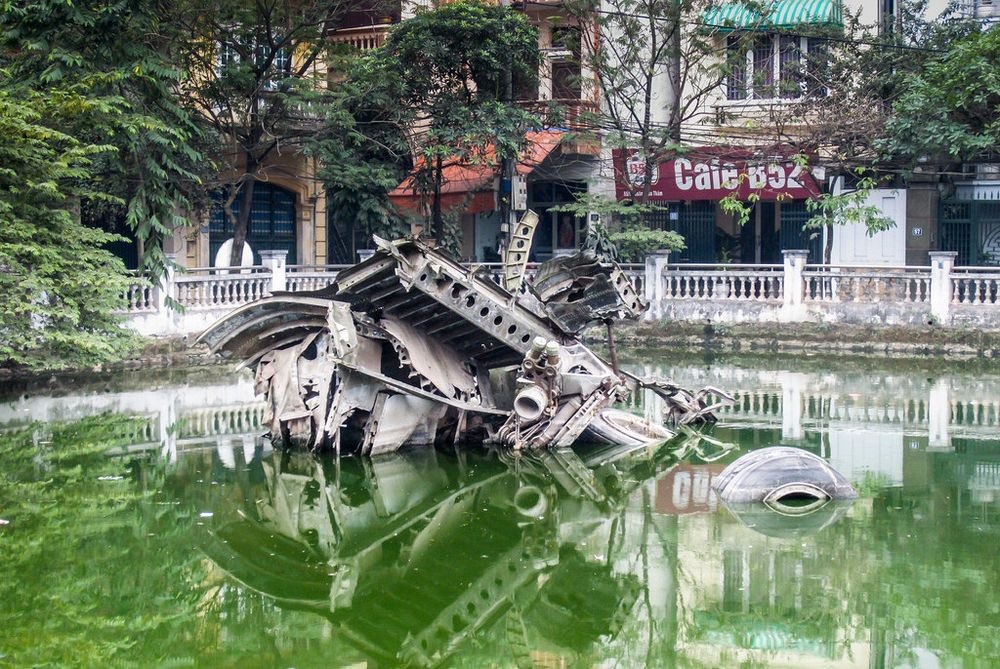
The water is calm now. Lotus leaves drift across the surface. Not really but, it sounds good for the story. In one corner, the tail section of a B-52 rests where it fell on December 27, 1972—the final night of a military operation named Linebacker II. If there was a plaque nearby it would explain that the plane was brought down by an SA-2 missile, fired by the 72nd Battalion. Six USAF American crew members were on board that day. Three survived and became prisoners. Three did not.
I stood there a long time before it was time to move on. The lake doesn’t shout. It just holds the story.
“In the quiet ripple of a lake that once caught a falling pilot, Vietnam whispers: We remember the pain, but we choose the peace.”
Truc Bach Lake
A short jeep Ride away, another still body of water. This one much larger than the previous one that was about the size of a large American swimming pool back home—compact, almost intimate, surrounded by a wall and an alleyway.
But once, the entire area around it was nothing but rice paddy fields stretching as far as the eye could see.
Today, those fields are long gone, replaced by buildings rising close in on every side.
We stepped out of the Soviet-era jeep to reach the water’s edge. Hundreds of scooters usually stream through these lanes, but today was Sunday. Most people weren’t working. The streets were somewhat calm, the air softer. A rare quiet in Hanoi.
This is where, on October 26, 1967, Lieutenant Commander John McCain ejected from his stricken A-4 Skyhawk after it was hit by an SA-2. He landed here, injured, and was pulled from the shallow water by local residents.
And if there was a small stone marker it would now read something understated like “forced landing.” Respectful. The lake is peaceful—children play nearby, old men fish, couples stroll.
History doesn’t disturb the present here. It just shares the space.
Hoa Lo Prison – “Hanoi Hilton”
Five hundred meters southeast, part of the old French-built prison still stands. During the war, it held over 500 American pilots, including Senator McCain, who spent five and a half years within its walls. He endured solitary confinement, injury, and pain—yet refused early release out of solidarity with his fellow prisoners.
The museum preserves the cells, the leg irons, the guillotine room from colonial days. It tells the Vietnamese story of resistance, too—farmers, students, mothers who fought for independence.
Both truths live here, side by side. Not perfectly balanced, perhaps, but honestly presented.
The gift shop sells coffee mugs with the prison’s nickname. I didn’t buy one.
Food, Shared
Lunch was simple, generous, and humbling. Rice-noodle rolls filled with fresh herbs. Grilled pork skewers, lightly sweet. A salad of greens and flowers—bright, bitter, alive.
Back home, I thought I knew Vietnamese food. I didn’t. This was lighter, greener, more thoughtful. Every bite felt like gratitude.
Night Walk – Old Quarter
Another evening, another slow wander. 18,000 steps through narrow streets lit by lanterns.
We tried:
Bún chả – pork grilled over charcoal, served in warm broth
Bánh cuốn – delicate rice crêpes, folded around pork and mushrooms
Egg coffee – rich, slow, a small ritual in a cup
Ninh Binh – Mountains and Memory
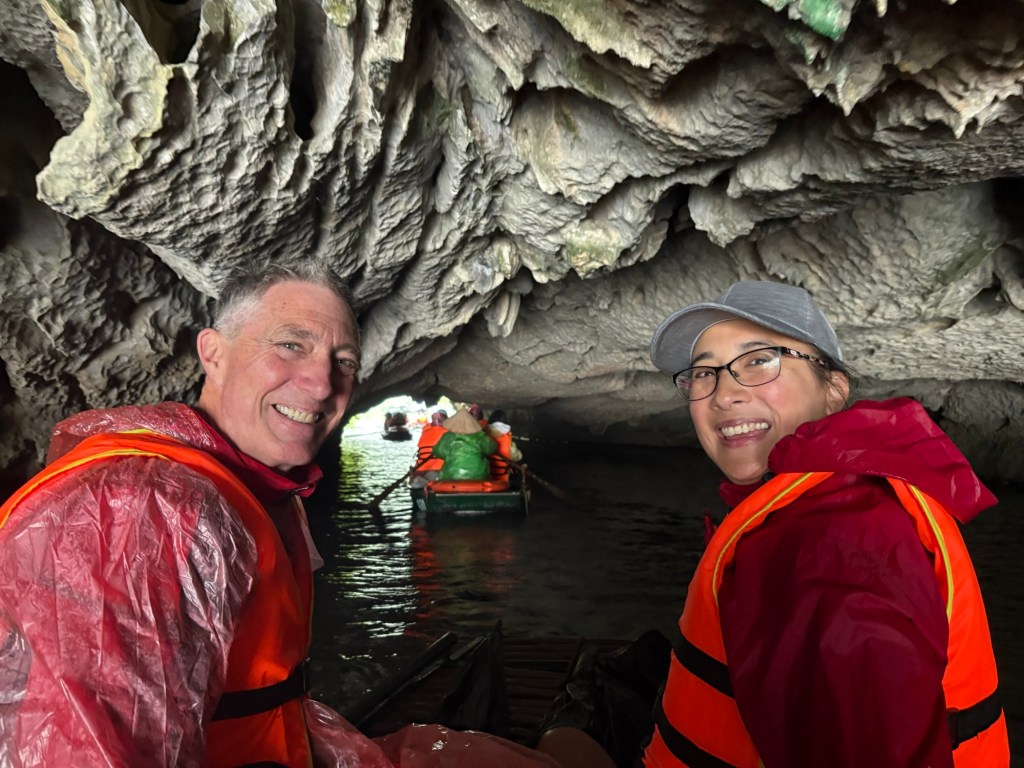
A day south of Hanoi, the landscape opens into something ancient. Towering limestone peaks rise from rice fields like sleeping giants. A woman rowed us in a flat boat through Tam Coc as rain fell soft and steady. I met new lifelong friends from Australia, Merlin and Natalie.
“Your friends will know you better in the first minute you meet than your acquaintances will know you in a thousand years.” — Richard Bach.
Lunch overlooked the paddies: spring rolls, catfish cooked in clay, morning glory sautéed with garlic. Simple. Perfect.
Later, 486 stone steps led to a ridge-top temple—built in the 10th century by Emperor Đinh Tiên Hoàng, who chose this nearly impregnable place to unify the nation. The view was worth the climb. The silence, even more.
Cu Chi Tunnels – A Sobering Reminder
In the south, near Ho Chi Minh City, I crawled through a short section of the Cu Chi tunnel network.
Above ground, the jungle has reclaimed everything. Birds sing. Tourists take photos. The earth keeps its secrets.
Fifty Years On
The Vietnam War ended in 1975—fifty years ago this year. Half a century.
And in that time, the Vietnamese people have done something extraordinary.
From the ashes of conflict, they rebuilt. Not just buildings—though Hanoi’s skyline now gleams with glass and steel where rice fields once stood. Not just roads—though highways now connect north to south, and high-speed trains are on the way. Not just schools—though literacy is near universal, and universities turn out engineers, doctors, and innovators by the tens of thousands.
They rebuilt hope.
Poverty, once crushing, has fallen from over 70% in the 1980s to under 5% today. Life expectancy has also risen by nearly twenty years. Exports—coffee, rice, electronics, textiles—power a booming economy. Ho Chi Minh City pulses like Singapore. Hanoi blends tradition and progress with quiet confidence.
Children born long after the last bomb fell now design fashion, and welcome visitors with open hands and warm smiles. The war is history. The future is theirs.
Reflection
Tours weave through the snarl of traffic, the murmur in foreign tongues, and shield me from the unseen shadows—so that I may drink in the whispers of the wind, feast my eyes on the kaleidoscopes of light, and cradle every fleeting moment in the velvet of my memory.
I’ve already lost count of the steps, the meals, the quiet moments of making new friends. My body has probably already gone through a reboot due to the much healthier diet. My belt feels a little looser. My heart definitely feels a little fuller.
Vietnam doesn’t need me to fix its past. It doesn’t ask for pity or praise. It just invites you to come visit, take in the sights, best if done by tours, walk, eat humbly, and look closely.
Next Stop: Sapa
A few more days before the rest of my motorcycle group arrives. I’ll spend them in the mountains—trekking, staying with a local family, deeper in thought and how silence sounds.
Until then, I’ll keep walking.
Keep listening.
Keep remembering.
Ralph
November 2025

 Trawlercat Chronicles